
The Building Safety Manager title sounds very official. For example, you might picture someone in a tall building, clipboard in hand. This person guides the work on Statutory Compliance. In fact, much of that image is true. But what really happens behind that professional look?
Honestly, being a Building Safety Manager is tough work. Instead, you must be a detective, a peacekeeper, and a record keeper all at once. Plus, you constantly ensure Statutory Compliance. This happens even while searching for old documents, like a missing 1980s pipe diagram.
Welcome to a day in the life. Leave your old ideas outside. Grab a high-vis vest, and let’s look closer at the job.
Phase 1: The Digital Fight for Statutory Compliance (The Morning Audit)
A Building Safety Manager’s day doesn’t start on the roof. Instead, it starts with a deep dread of the inbox.
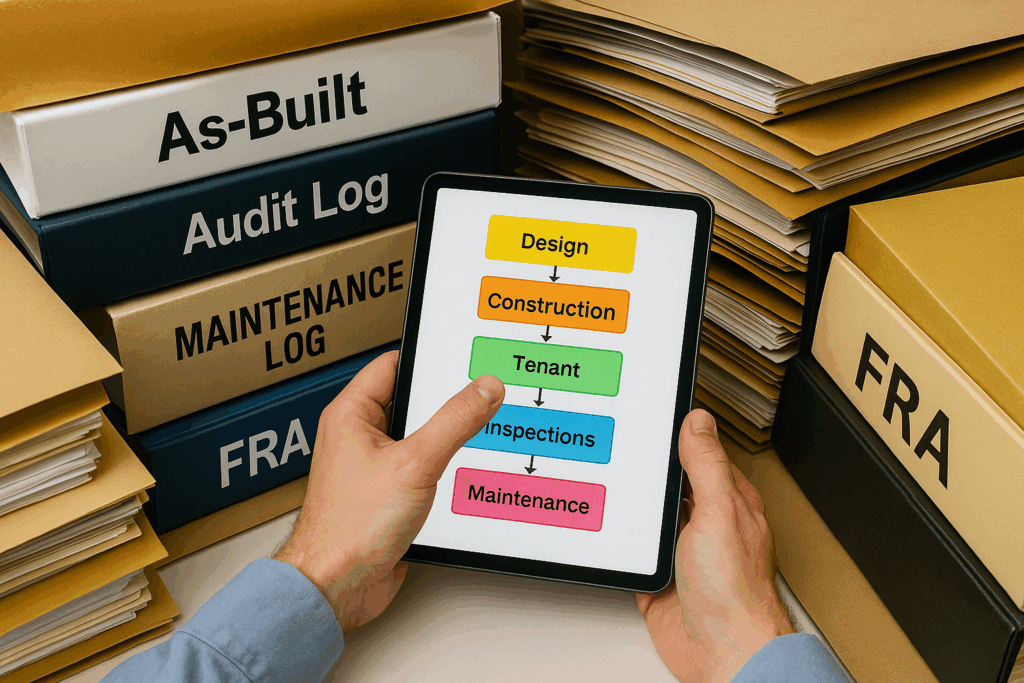
The Building Safety Act (BSA) changed everything. Clearly, this law created complex rules. In turn, the office work got much heavier. Therefore, the main focus now is the Golden Thread of information.
For most people, the Golden Thread is a simple idea. It is the single, accurate, digital record of a building’s history. This includes design, building, and daily use. As a result, you must keep and use this record for the building’s full life. Simply put, for the Building Safety Manager, this means one thing: data is key.
08:00 Data Audit: Taming the Golden Thread for Statutory Compliance
Your first hour involves dealing with files. Therefore, you must ask: Did the contractor upload the right certificate? Did the maintenance team record that boiler repair correctly? Furthermore, is the fire door inspection report correctly filed? Is it linked to the fire risk assessment (FRA)?
You act as a high-stakes librarian. Your users are the Regulator, the Accountable Person, and the emergency services. Crucially, an error here isn’t a simple fine. In fact, it’s a breach of Statutory Compliance. Your morning coffee helps you focus, because you need to spot one detail wrong in hundreds of pages.
09:30: Mandatory Occurrence Reporting (MOR)
Next, comes Mandatory Occurrence Reporting (MOR). Essentially, you are legally required to report incidents. You also report near-misses and safety issues to the Regulator. Did a resident touch a smoke detector? Did a contractor use the wrong material? Above all, this reporting needs to be very accurate. You must quickly decide the seriousness and what action you took at once.
Witty Thought: In all seriousness, the true heroes in building safety jobs are the ones who can handle the MOR portal.
Phase 2: Site Inspection and Upholding Statutory Compliance
The clipboard finally gets used. This is the day in the life image most people expect. You check the physical safety of the building. Even so, every site visit has two major parts. These are the fire safety check and the Resident engagement check.
The Two-Part Walkabout: Fabric and Feedback
First, you are on site. You check those important flat entrance doors. Does the self-closer work? Is the gap around the frame safe? Is the seal working? As a result, you spend a lot of time gently testing fire-rated items. You walk past a door that looks fine. But the records show it was installed wrong five years ago. So, the detective work starts. You check the as-built drawing against the current inspection report.
Inspection Part 2: Working with Residents
A Building Safety Manager deals with structure and people. Indeed, people notice things. As it happens, the most critical safety issue often comes from an unexpected source.
- “My shower pressure is low.” (Result: A contractor ran an unapproved pipe through a protected area.)
- “The plant room smells funny.” (Result: A crucial filter is missing.)
- “My neighbour stores tons of old newspapers on their balcony.” (Result: This is a serious fire hazard.)
The clipboard becomes a shield. You need to be a kind diplomat and a strict officer. You check for breaches of the Residents’ Duties under the BSA. However, you also reassure them that you record their worries in the essential Golden Thread.
Phase 3: The Stakeholder Olympics (Afternoon Mediation)
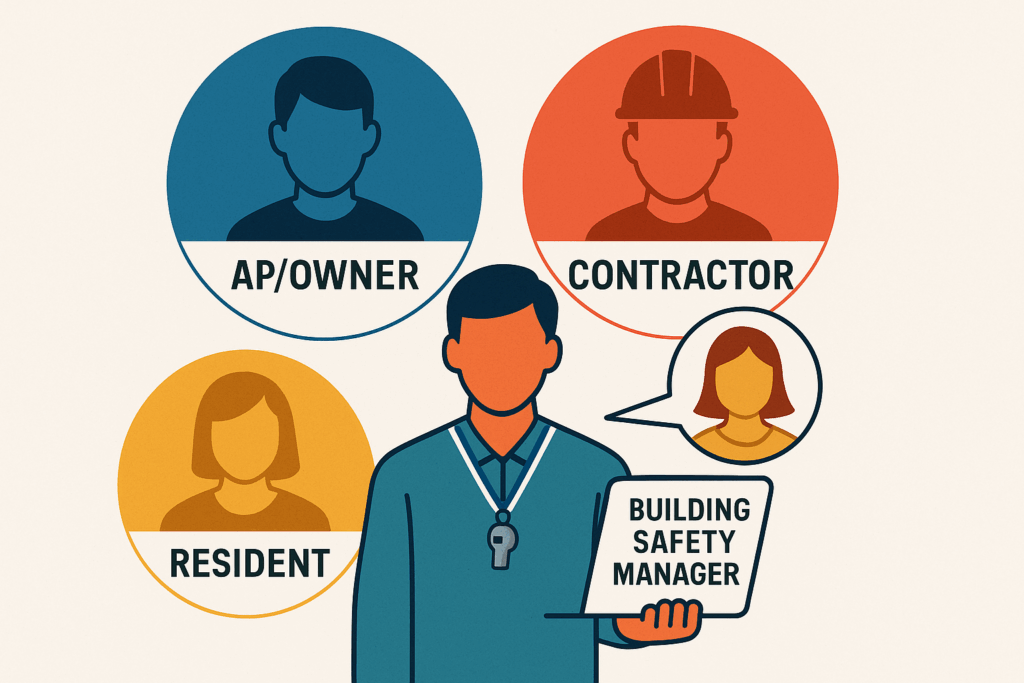
Around lunchtime, the Building Safety Manager becomes a translator. You mediate between different building and property groups. Specifically, you handle communication between all parties.
13:00: Auditing Competence and Achieving Statutory Compliance
A new repair is necessary. You hire a contractor.
Your job isn’t just to approve the work. Instead, you must check their competence or skills. You check their certificates, insurance, and past work. Next, you ensure their plan matches the building’s safety plan.
- Scenario: A plumber gives a quote. You ensure they know one thing. They cannot drill through a fire wall without proper fire-stopping afterwards. Furthermore, the proof of that fire-stopping goes into the Golden Thread right away. This clearly defines and ensures Statutory Compliance.
14:30: Briefing the Accountable Person (AP)
You have regular meetings with the Accountable Person (AP). This is usually the building owner. At this point, the importance of building safety jobs becomes clear.
The AP holds the main legal duty. And you, the Building Safety Manager, give them the proof they need to be compliant. Also, you actively write the Safety Case Report. This document formally proves the building is safe.
Your talk is not about costs. Rather, it’s about risk. You say, “Risk level is X because of defect Y. But our fix Z (maintenance/alert) reduces the risk to an acceptable level W.” In short, you constantly study risk. This turns daily maintenance into strategic safety management.
Phase 4: The Digital Deep Dive for Continued Statutory Compliance (Evening Focus)
As the day ends, you go back to the digital tasks. Truly, this is the quiet, hard work of checking data. Furthermore, it is the secret of the Building Safety Manager UK.
16:00: Data Integrity and Statutory Compliance Checks
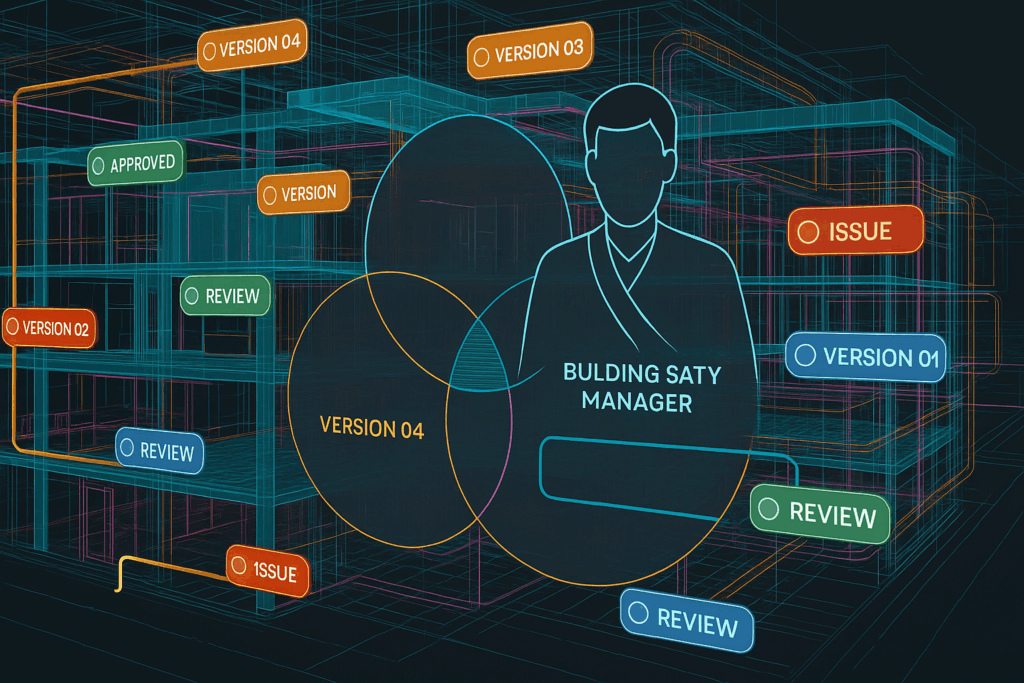
You might spend an hour working with digital models (BIM/CAD). You do this not to design anything new. Instead, you ensure the digital model perfectly matches the real building. This includes every small change made over the years.
Version control is vital for Statutory Compliance. For instance, you see a drawing named “2024 Final.” But the Regulator’s system says the latest version is “Revision B.” You have a Golden Thread breach. Therefore, you must find the difference and correct the records.
Consequently, this task makes the Building Safety Manager UK role much more than traditional management. It is technical, exact, and needs strong digital skills.
17:30: The Personal Competence Checklist
Before leaving, a good Building Safety Manager checks their own skills. Did they log all their training hours (CPD)? Did they review the latest safety guides?
The BSA era makes personal competence a legal rule. You are not just relying on your company. Instead, you are personally responsible for having the right skills and knowledge. Indeed, you form part of a new professional group. In this group, continuous learning is a legal necessity.
The Verdict: More Than Just a Title
So, what really happens behind the clipboard?
It is a high-stakes mix of engineering, talk, law, and focus. The Building Safety Manager UK holds the Golden Threadtogether. They manage the physical risks of the building. Simultaneously, they manage the digital risks of non-compliance and Statutory Compliance.
It is a challenging and rewarding career. It is for people who love complex tasks and exact details. Therefore, if you want one of the most vital building safety jobs in the country, be ready to be an audit expert. You will still occasionally tell a resident that their patio heater is a fire risk.
And honestly? We wouldn’t have it any other way. Now, if you’ll excuse me, I think the lift just stalled. I need to cross-reference the maintenance log with the statutory inspection certificate. The clipboard calls.