How to Craft the Perfect Building Safety CV for Career Progression
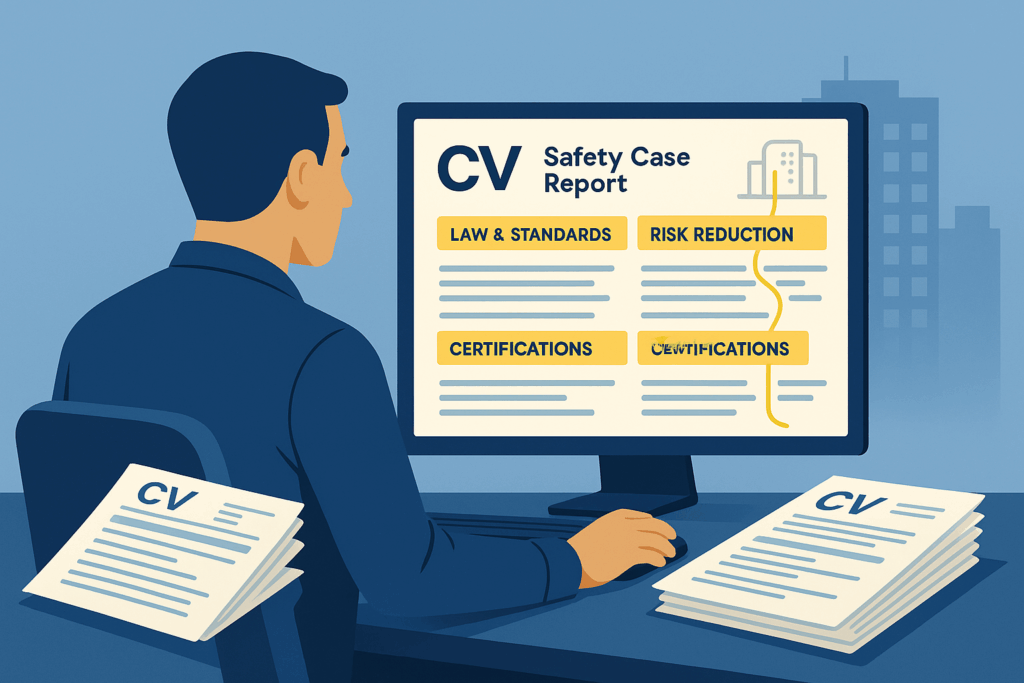
Your Building Safety CV is more than just a list of old jobs. The Building Safety industry has changed a lot. First, the focus is no longer on simply fixing things. Instead, we now focus on careful, planned risk management. Because of this, your CV must act as your personal Safety Case Report. In short, you need to show clear proof and skills. You must prove you are the safest choice for your next job. Therefore, knowing how to build a strong Building Safety CV is vital.
This guide is for professionals who want to get senior jobs. For example, these roles include Building Safety Manager (BSM), Fire Risk Assessor (FRA), or Compliance Lead. Also, we will teach you how to master the ATS system. Furthermore, we’ll show you how to use numbers to prove your impact on safety.
Section 1: Beat the ATS—Use Keywords on Your CV
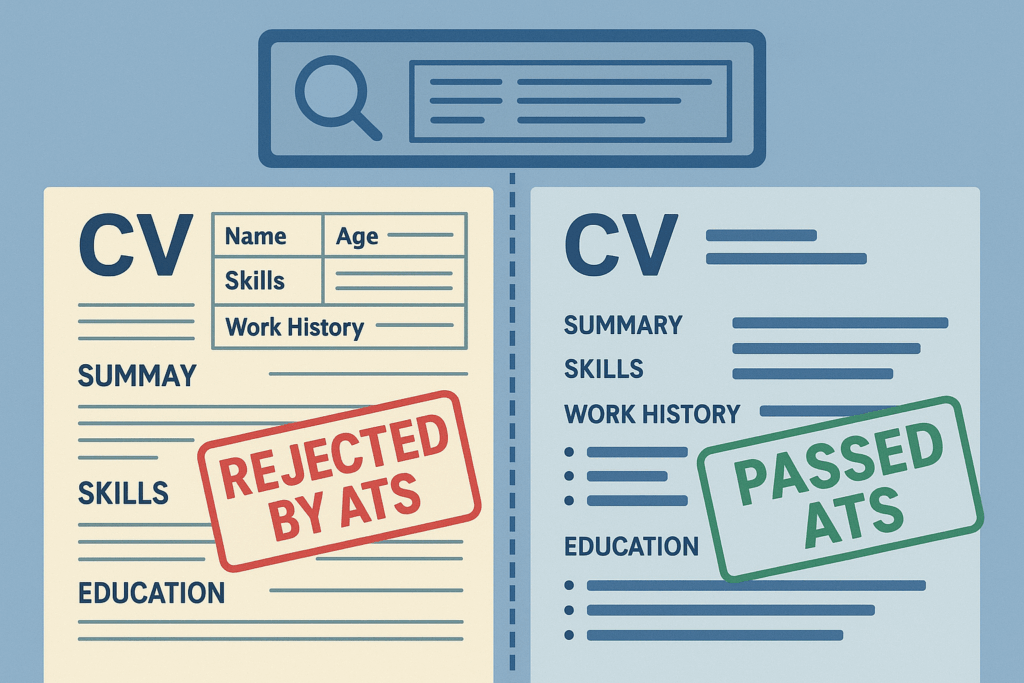
Your Building Safety CV must pass a computer check first. This check is done by the Applicant Tracking System (ATS) . Large firms use this software. Consequently, the ATS filters candidates based on keywords and CV layout. Hence, if your CV score is too low, a recruiter may never see it.
What the ATS Looks For on Your Building Safety CV
The ATS turns your document into simple text. After that, it checks this text against the job ad.
| ATS Mistake | ATS Success |
| Complex tables, fancy fonts, images. | Simple layout, common fonts (Arial, Calibri), clear headings. |
| Vague phrases like “In charge of safety.” | Specific terms like “Golden Thread” Management. |
| Saving the file as a PDF (unless asked). | Saving as .docx (Word) for better reading. |
Must Have Keywords for the Safety Sector
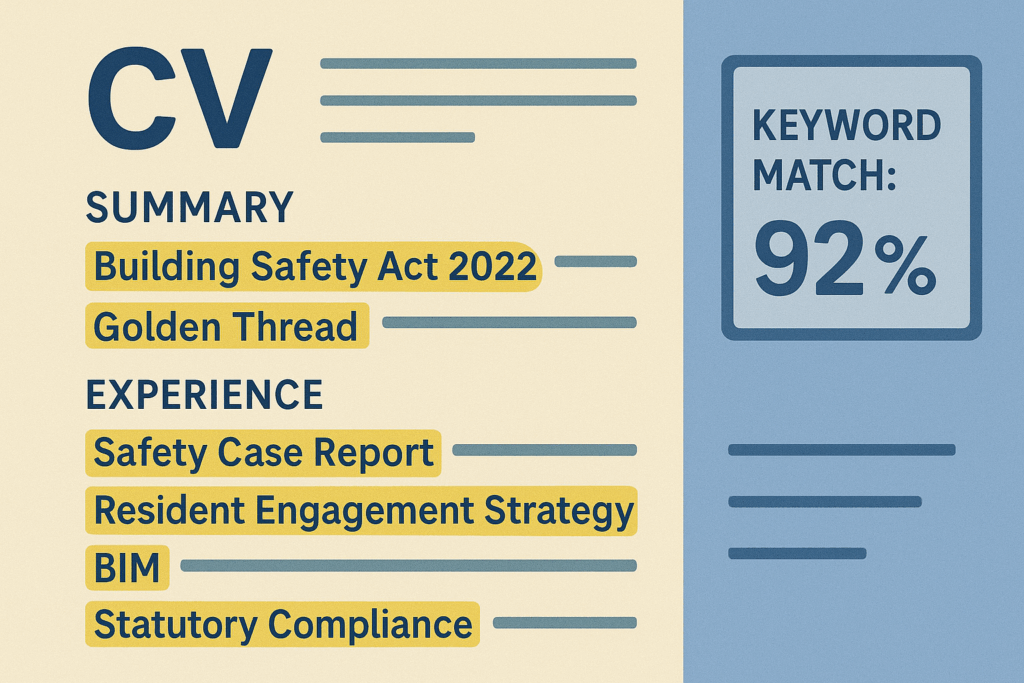
You must add specific, key words to your profile. This is most important in your Core Skills section. In addition, use a mix of technical, legal, and operational words.
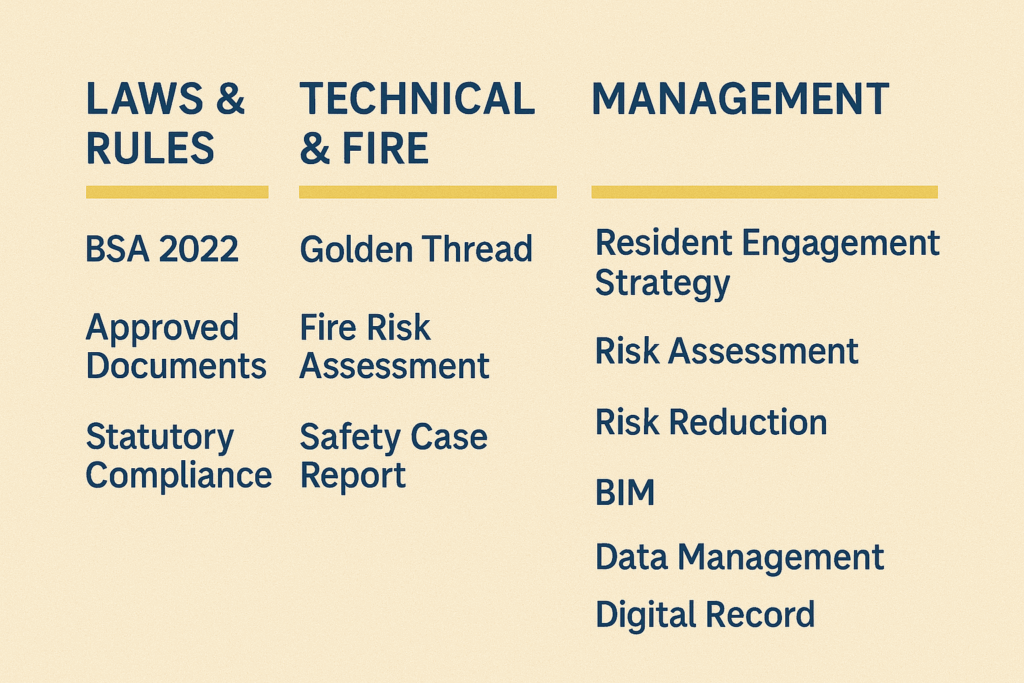
| Group | Key Words to Include |
| Laws & Rules | Building Safety Act 2022 (BSA), Statutory Compliance, Fire Safety Order 2005 (FSO), Health & Safety Executive (HSE), Regulatory Reform. |
| Technical & Fire | Golden Thread, Safety Case Report, Passive Fire Protection (PFP), Fire Door Inspection Scheme (FDIS), Remediation Strategy. |
| Management | Resident Engagement Strategy, Mandatory Occurrence Reporting (MOR), Principal Accountable Person (PAP), Continuous Professional Development (CPD). |
| Systems & Data | BIM (Building Information Modelling), Asset Management Systems, Data Integrity, Version Control. |
Tip: Print the job ad. Next, highlight the 10-15 most technical words. Then, make sure those exact words appear naturally at least once on your Building Safety CV. Otherwise, the ATS might miss you.
Section 2: How to Set Up Your Building Safety CV
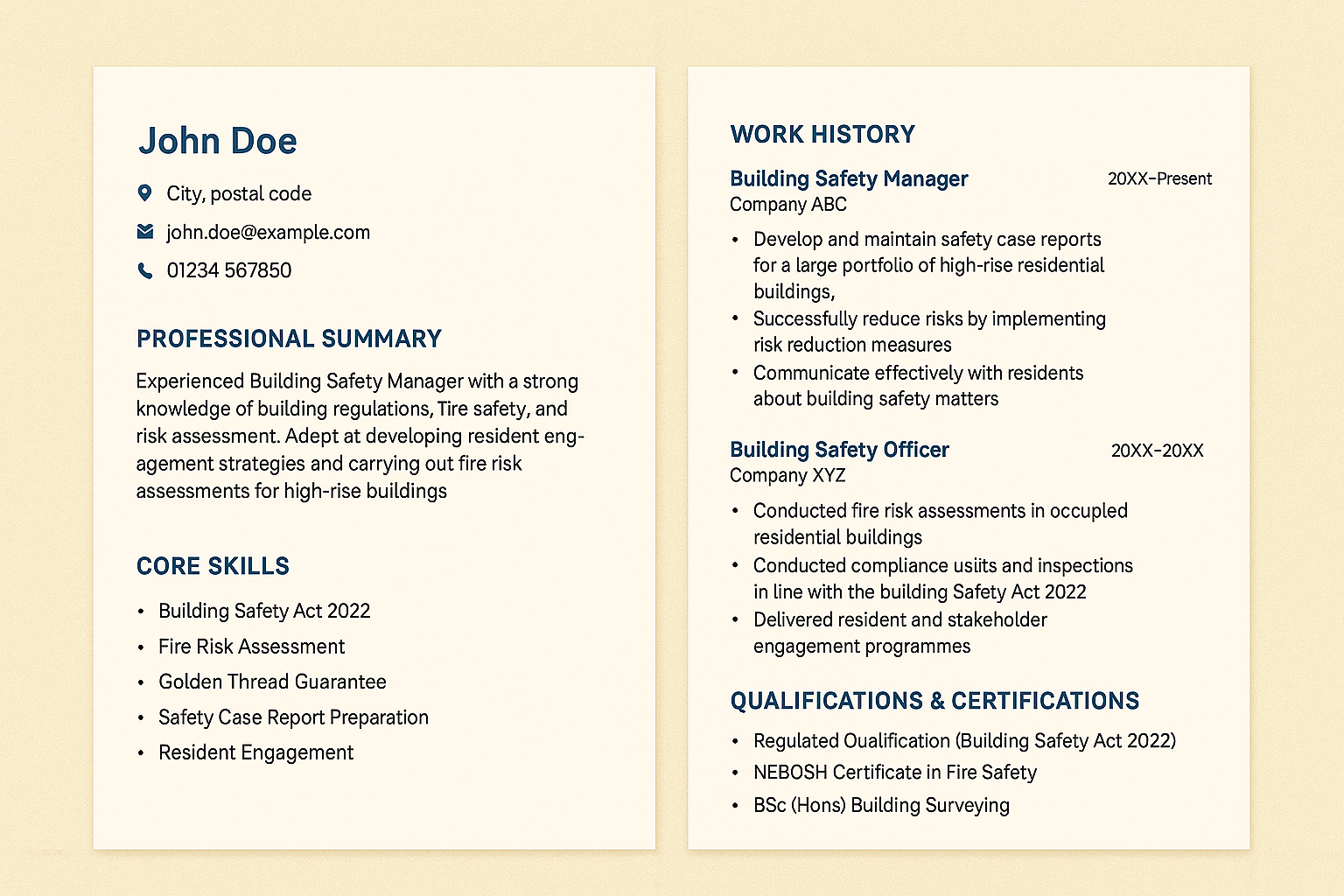
A good Building Safety CV must be easy to read and set up well. Remember, it should only be two pages long. The exception is if you have over 15 years of senior experience.
1. Contact Information
Must Haves: Name, Phone Number, Work Email, LinkedIn Profile Link.
Options: Your general location (e.g., “London Area”). But never include your full home address.
2. Professional Summary
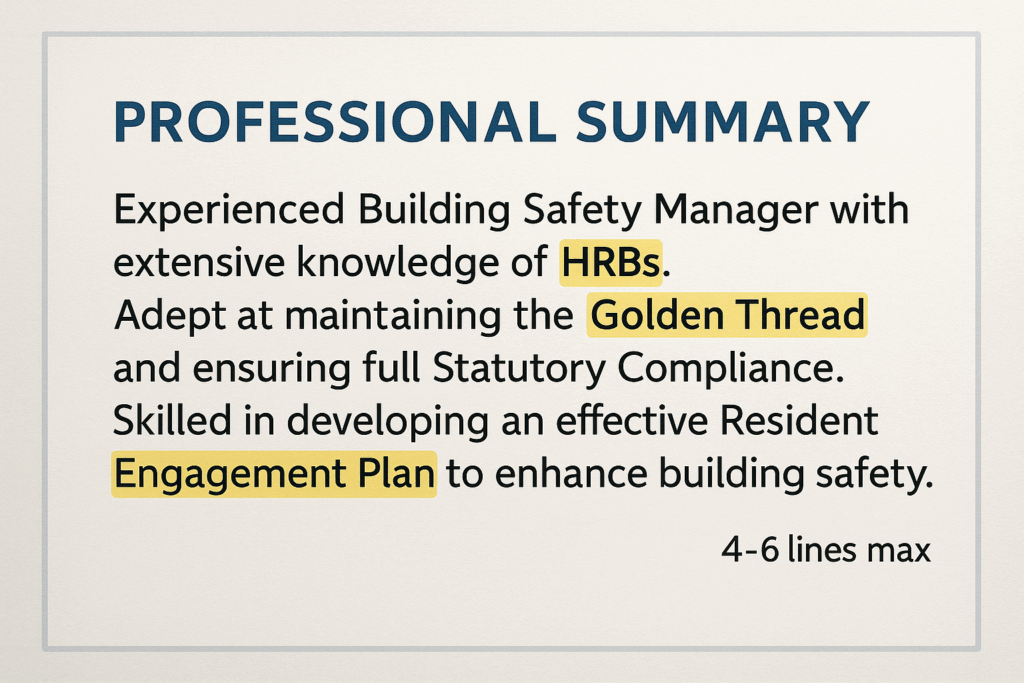
Length: 4–6 lines is the maximum.
Content: This part is key for the ATS and the hiring manager.
Above all, it must quickly state your career level. Plus, it should include 3–5 key keywords.
Example (BSM Focus): Experienced Building Safety Manager (BSM) with 8+ years in tall residential buildings (HRBs). I successfully built and kept the Golden Thread. I also made sure we met all Statutory Compliance rules. Finally, I set up strong Resident Engagement Plans under the BSA 2022.
3. Core Skills
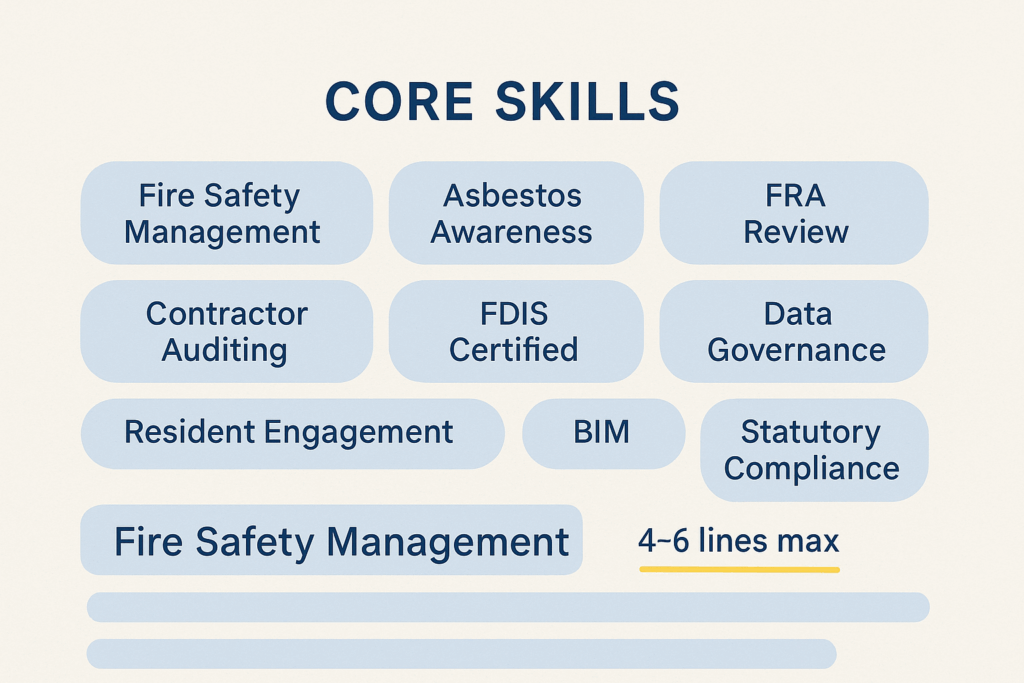
List 8–12 specific skills using bullet points. This setup gives the ATS a fast keyword hit. In addition, it gives the recruiter a quick view of your technical knowledge.
Example: Fire Safety Management, Asbestos Awareness, FRA Review, Contractor Auditing, FDIS Certified, Budget Management, Data Governance.
4. Work History
List your last 10–15 years of related work here. Most importantly, focus on things you achieved, not just your duties.
Format: Job Title, Company Name, Dates (Month/Year – Month/Year).
The Starter Sentence: For each job, use a strong first sentence. This defines the size of your role (e.g., “Led fire safety for 15 tall blocks, affecting 4,000 residents.”).
Use Numbers: Use bullet points that start with a strong action word (Managed, Led, Reduced, Delivered). Then, follow it with a result you can measure (see Section 4).
5. Qualifications
List your best or most important training first. Therefore, start with the most recent or relevant qualification.
Focus on Certs: Put industry certificates (NEBOSH, FDIS) before your university degrees. This is true only if they relate directly to the job. Furthermore, these show your skill level.
List CPD: Briefly mention your ongoing learning (CPD) (e.g., “Active CPD log kept, focused on new HSE advice.”). Ultimately, this proves dedication.
Section 3: Change Your Building Safety CV for New Roles
Using the same CV for every job is the biggest mistake. To move up, you must change your Building Safety CV. Specifically, show the exact skills the new job demands.
Path A: Building Safety Manager (BSM) Focus
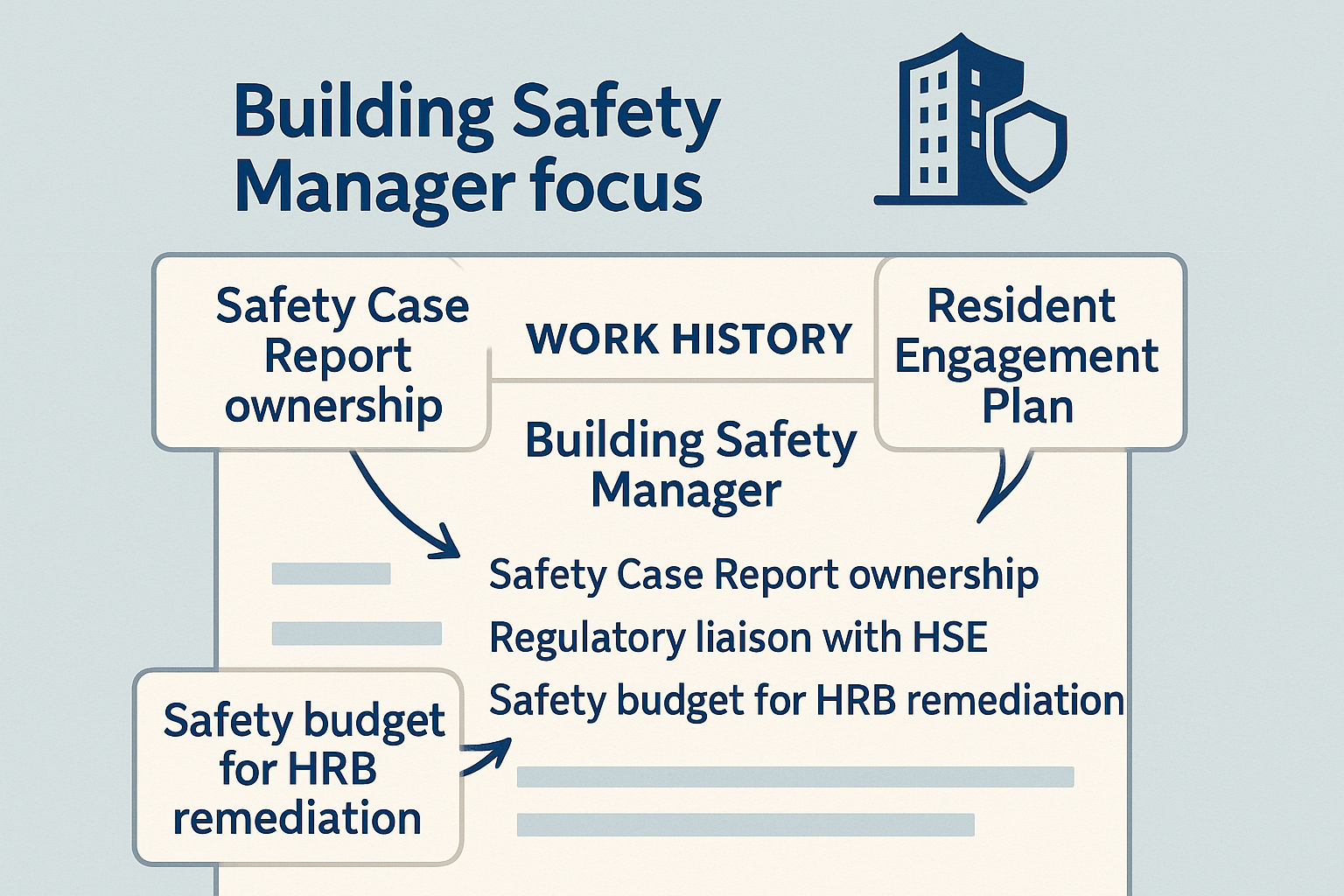
The BSM role is strategic. It mostly focuses on high level responsibility, risk ownership, and talking to the PAP. Therefore, your CV should show leadership and rule-setting.
Key Areas to Show:
- Strategy & Policy: Writing the Safety Case Report. Creating the Resident Engagement Plan.
- Accountability: Being the main contact for the Regulator (HSE). Managing the budget for safety repairs.
- Data Governance: Setting up and checking the Golden Thread systems. Leading data checks. Keywords to Use:Governance, Accountability, Strategic Oversight, Regulatory Liaison, Safety Case Ownership, Stakeholder Management, Assurance.
Metric Example: “I led the first Safety Case Report for a tall building (Category A HRB). We finished the internal sign-off 3 weeks before the Regulator’s deadline.”
Path B: Fire Risk Assessor (FRA) Focus
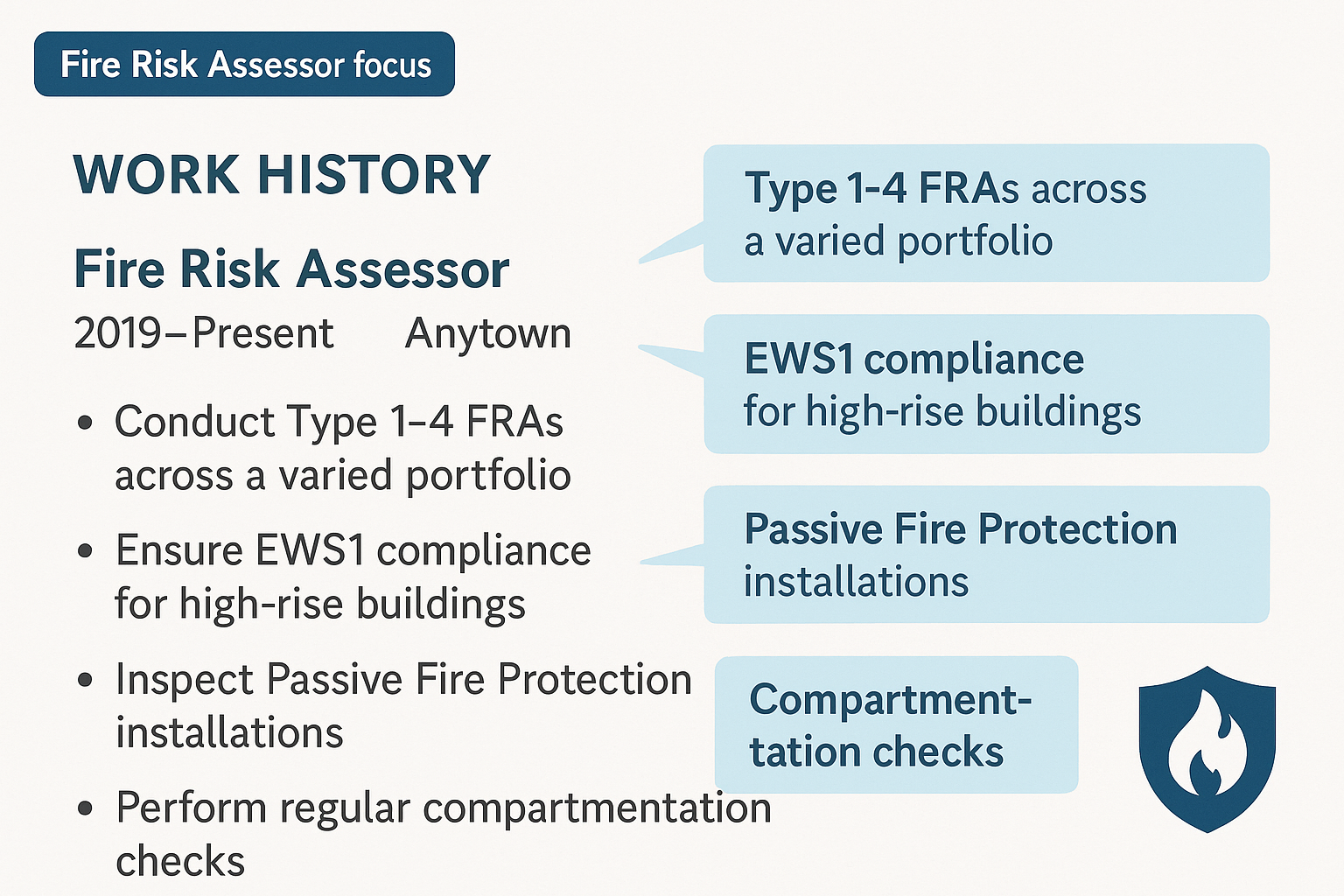
This path is highly technical. As a result, it needs a perfect knowledge of fire science and construction. Thus, your Building Safety CV must prove deep technical skill.
Key Areas to Show:
- Inspection: Doing Type 1, 2, 3, and 4 Fire Risk Assessments. Expert knowledge of outside wall systems (EWS) and passive fire systems.
- Law Knowledge: Showing a deep understanding of the Fire Safety Order 2005. Knowledge of the Building Regulations.
- Reporting: Writing legal, useful FRA reports. Deciding which repairs are most urgent based on risk.
- Keywords to Use: Passive Fire Protection (PFP), Fire Stopping, Compartmentation, Type 4 FRA, EWS1 Compliance, Fire Safety Strategy.
Metric Example: “I finished over 75 Type 3 and 4 FRAs in 12 months. This led to closing 95% of high-risk tasks within 90 days.”
Path C: Compliance Lead Focus
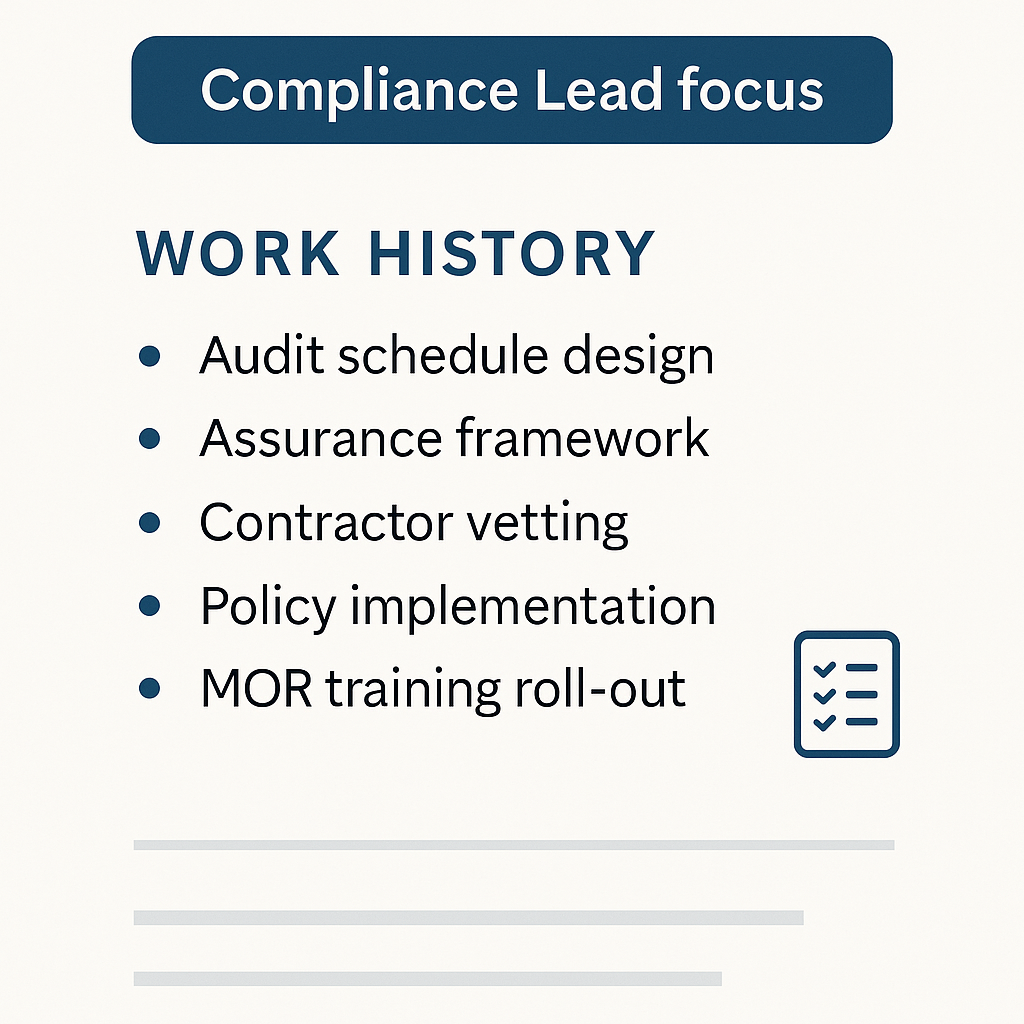
This job is about checks, processes, and making sure the company follows all laws. Accordingly, your CV should highlight process control.
Key Areas to Show:
- Audit and Check: Creating the internal check schedule. Checking contractor skill records.
- Policy Work: Writing internal compliance rules. Turning complex laws into simple work guides.
- Training: Starting new training for staff and contractors (e.g., MOR rules).
- Keywords to Use: Audit Protocol, Regulatory Compliance, Policy Implementation, Data Governance, Assurance Framework, Due Diligence, Contractor Vetting.
Metric Example: “I designed and started a new contractor checking system. This reduced faulty contractor work by 40%. It also resulted in a 100% pass rate on the last HSE audit.”
Section 4: Use Numbers to Show Your Success
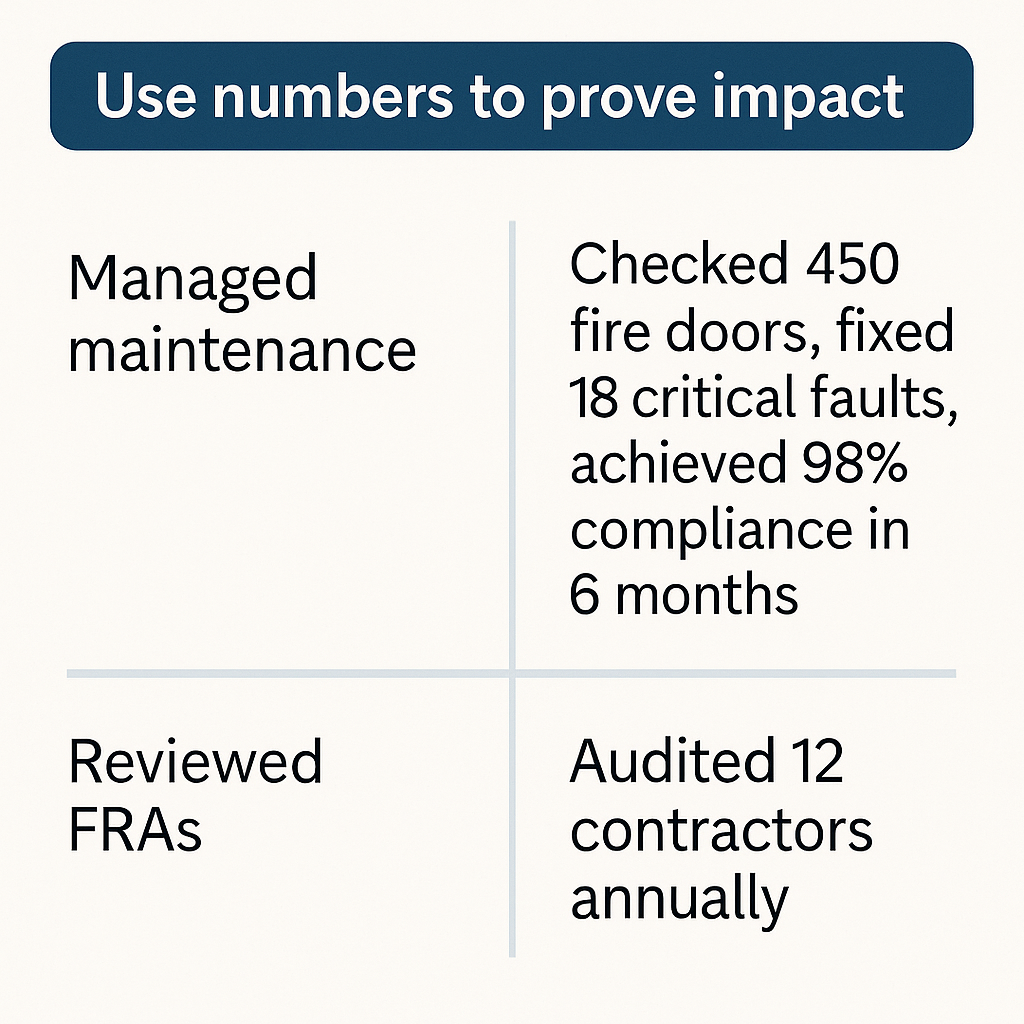
Recruiters don’t want to read what you did. Instead, they want to know how much safer the building became because of you. Therefore, your CV must state the action and the result clearly.
Rules for Using Numbers
- Safety = Risk Lessened: The best number shows you made something safer. This is vital.
- Efficiency = Time/Money Saved: Show that you made processes better.
- Compliance = Percentage: Prove you closed gaps or got perfect scores. Always use high numbers.
Strong Safety Metric Examples
Do not write, “Managed maintenance.” Instead, use these clear, number-based statements:
| Weak Sentence | Strong Sentence (Uses Numbers) |
| I handled the data for the new safety law. | I set up the Golden Thread data store for 12 tall buildings. This led to a 100% data check score before the deadline. |
| I checked all the fire doors. | I checked over 450 fire doors. I managed repairs for 18 critical faults. This meant a 98% compliance rate in 6 months. |
| I wrote the emergency plans for residents. | I created and started new PEEP and GEEP documents. This caused a 30% jump in resident involvement. |
| I reduced contractor audit failures. | I started a two-step contractor sign-up process. This successfully cut bad contractor work by 55% in the first three months. |
| I looked at the fire risk assessments. | I reviewed 40 old FRAs completely. I found 5 key compliance gaps and built a 3-year repair budget of £1.2M. |
The Formula: Action Verb + What was done + Measurable Result ($, %, #, or Time Saved).
Section 5: Your Certifications
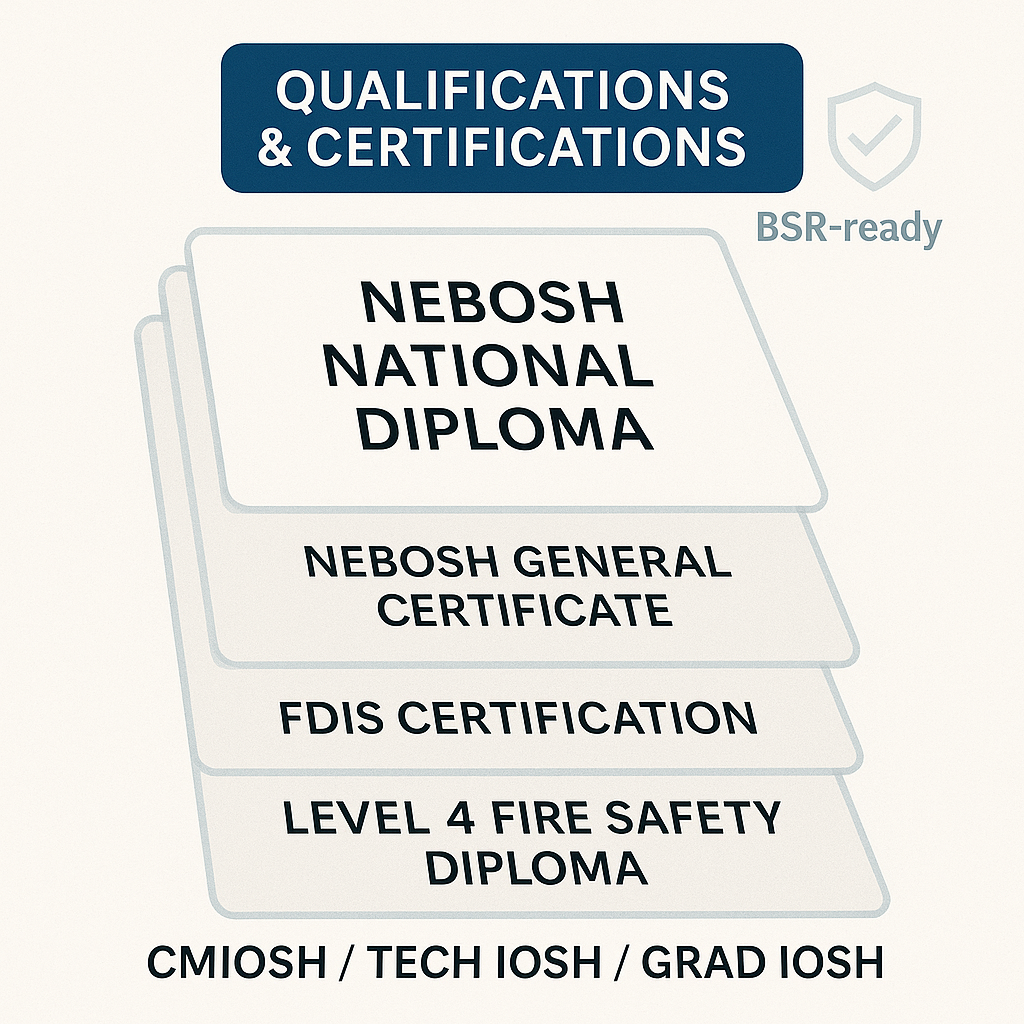
In this regulated field, your certificates are your professional proof. For this reason, the hiring manager must quickly see that you meet the basic skill needs.
Must Have Certifications
The order matters here. Hence, put your highest-level or most relevant certificate first.
1. Core Skills:
- NEBOSH: These are the standard for safety skill.
- Best: NEBOSH National Diploma (shows senior knowledge).
- Minimum: NEBOSH National General Certificate (the basic level).
- Fire Safety:
- FDIS Certification: This is key for checking building parts.
- Level 4 Diploma in Fire Safety: Very wanted for FRA and BSM jobs.
2. Memberships: Your membership shows you commit to work standards. Therefore, list it clearly.
- Chartered: CMIOSH or CEng are instant signs of seniority.
- Affiliation: List Tech IOSH or Grad IOSH clearly next to your name.
- BSR Registration: For BSM roles, show you know about future registration (e.g., “Ready to apply for BSR registration upon opening.”).
3. Ongoing Learning (CPD): A stale CV looks weak. Thus, show you are learning actively. Plus, document this learning.
- CPD Log: Say that you keep an audited CPD log.
- Short Courses: List relevant short courses: Asbestos Management, Working at Heights, or Mental Health First Aid.
Tip: Create a clear section called “Qualifications and Certifications.” For instance, list the certificate name, the giver, and the finished date. Never make the recruiter hunt for this key information.
Conclusion: Your Career Safety Case
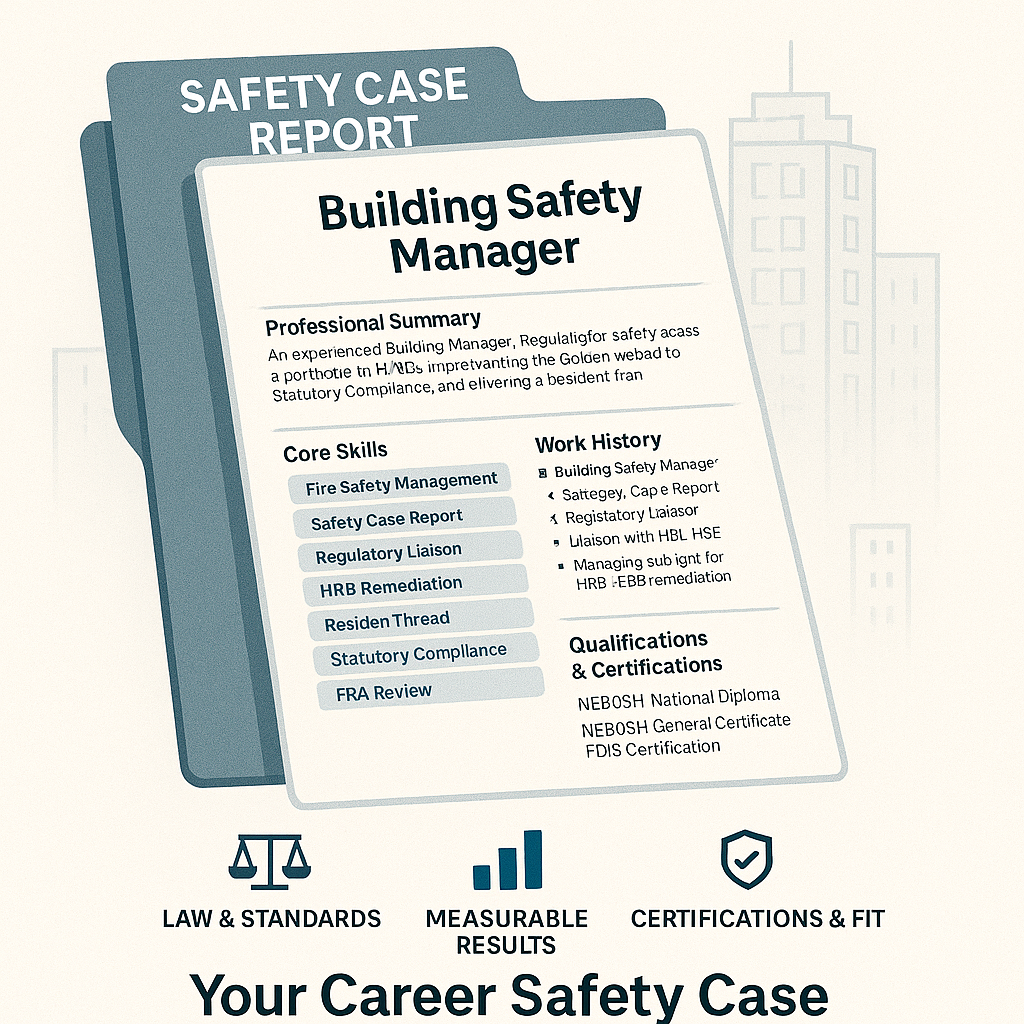
The Building Safety job market is very competitive. In conclusion, your CV cannot just list tasks to succeed. Instead, it must be your final Career Safety Case Report.
It must prove, without doubt, that you:
- Know the Law: By using key BSA and FSO words (Section 1).
- Get Results: By using numbers to show success (% and #) (Section 4).
- Have the Skills: By listing top certificates (NEBOSH, FDIS) (Section 5).
- Are the Right Fit: By tailoring your summary to the BSM, FRA, or Compliance job (Section 3).
In summary, by following these steps, your Building Safety CV will change. Ultimately, it becomes a powerful statement of skill, making sure your profile gets the attention it needs to secure your next big job.