

A new report shows big delays. Consequently, these delays slow down the BSR’s Safety Teams (MDTs) and directly hurt the current BSR Remediation Policy. The House of Lords wrote the report. In fact, it highlights big problems. These include low staff counts. Furthermore, it notes mixed guidance. However, the report misses a basic flaw. There is a conflict. Specifically, it is between safety ideas and strict rules. This happens during repairs. Therefore, this is a huge issue for the future of BSR Remediation Policy.
Thus, fixing delays needs more than new staff. Instead, we need a new method. This method must be legal. First, it must join the risk based test (PAS 9980). Second, it must also meet the strict building rules. Consequently, this step is key. It clears the backlog. Finally, it ensures BSR Remediation Policy supports fair and right sized fixes.
I. The Lords’ Report: Delays Impacting Policy
The report gives vital feedback. Specifically, it says starting the regulator was a “good step”. However, industry leaders complain. For example, they point to delays that are too long.
As a result, approvals now take nine months. Sometimes, they take even longer. Therefore, this breaks the twelve week legal limit. Furthermore, these delays hurt housing. In addition, they leave people in unsafe homes.
The report suggests several key fixes:
- Training and Staff: First, give money for new staff. Also, hire more fire inspectors. Thus, this helps the BSR rely less on outside teams.
- Consistency: Next, give teams clearer rules. Consequently, this ensures checks are the same for everyone.
- Streamlining: Finally, remove ‘small jobs’ from the process. Alternatively, create a simple path for them.
Whilst these points are good, they only look at staffing. Conversely, the real issue is the law. Indeed, teams must use strict laws on flexible plans. Consequently, this creates a trap. Training alone cannot fix this. Ultimately, the current process hurts a practical BSR Remediation Policy.
II. The Core Conflict in BSR Remediation Policy: Risk vs. Rules
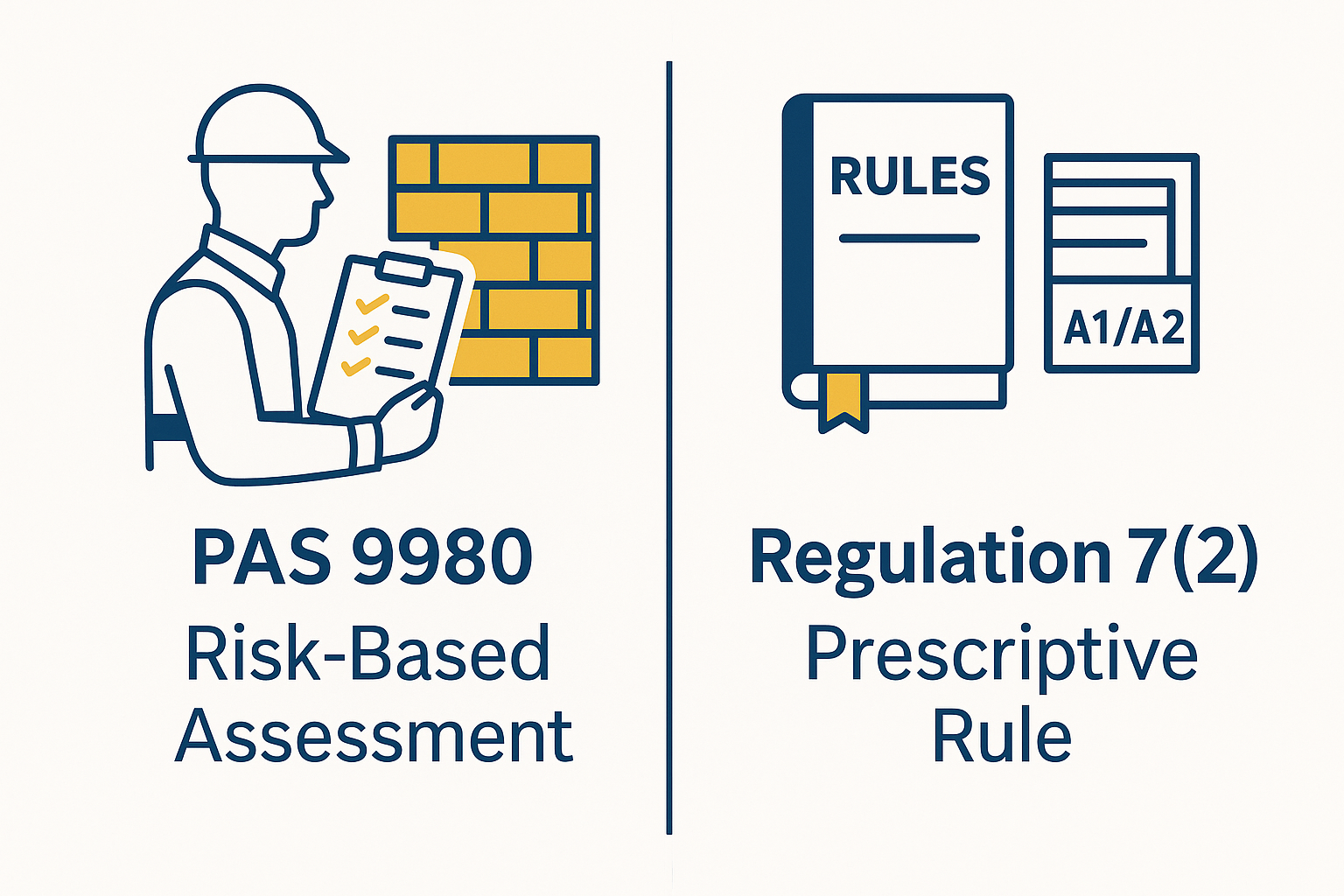
The conflict is clear. In fact, it sits at the center of the repair model.
A. The Risk Test: PAS 9980
The industry now uses a risk test. Specifically, this is for outside walls. Moreover, the Government requires the use of PAS 9980.
Consequently, PAS 9980 lets experts do a fair check. They judge the real risk to life. Therefore, the expert can suggest smart fixes. Crucially, they do not force a full rebuild.
In essence, this standard accepts some risk. Instead, it focuses on reasonable safety. Thus, this approach is flexible. It saves time. Additionally, it saves money.
B. The Strict Rule: Regulation 7(2)
The problem starts when plans reach the safety team. However, the team must check the work. Specifically, they check it against strict rules. This applies to Regulation 7(2).
This rule says: “New wall materials must not burn.” In other words, they must be class A1 or A2.
As a result, the team enforces this strictly. Therefore, any new wall work must use these materials.
C. The Dilemma in BSR Remediation Policy
This creates a conflict for BSR Remediation Policy.
- The Fair Plan: First, an expert suggests a fix. Remove bad cladding. Then, add fire breaks. Also, keep some old materials. This is safe enough. Thus, it is the fair choice.
- The Strict Rule: However, the team looks at the work. Reg 7(2) applies to new parts. Crucially, some teams think the whole wall must now be A1/A2. This applies even if the expert says it is safe.
Consequently, teams reject the plan. In fact, they feel they cannot approve it. Even if the plan fixes the danger, they say no. Therefore, this legal clash causes delays. Also, it causes the problems in the report. Ultimately, teams face a tough choice. Follow the strict rule? Or, accept a sensible BSR Remediation Policy solution?
III. The Fix: A Hybrid Model for BSR Remediation Policy
We cannot rebuild every tall building. Therefore, a strict rule for old buildings fails. First, it costs too much. Second, it takes too long. Furthermore, it stops urgent work. Thus, the solution is a new rule. This rule must join PAS 9980 and the strict laws.
A. Accepting Engineered Solutions
The regulator needs a clear path. Specifically, it must accept Engineered Solutions (FES). This must be for repairs.
For instance, if the work manages risk in an old building, the decision needs two things:
- Life Safety: First, does the plan show the risk is low? Indeed, it must follow PAS 9980.
- Fairness: Second, does the plan show why strict rules are bad? Often, replacing every part is too hard. Therefore, the plan must show this.
Thus, teams should check the result. Instead, they should not just check the material. Consequently, this change helps BSR Remediation Policy.
B. A Special Path for Repairs
The regulator should make a special path. Specifically, this is for repair approvals. In contrast, it is different from new buildings.
Therefore, this path must state the goal clearly. The goal is a ‘Reasonable Level of Safety’. In fact, this matches current safety standards. As a result, this gives teams legal safety. They can approve plans that keep some materials. However, this only works if the risk is managed.
Conversely, the old way forces rejections. Also, it stops smart solutions. Ultimately, this hurts government funding goals. Those goals want fair fixes.
IV. Improving Speed in BSR Remediation Policy
The rule conflict is the big issue. However, the report gives good tips too. Indeed, these tips help the team process. Thus, they help the new BSR Remediation Policy.
A. Consistency and Guidance
The report asks for consistency. Consequently, the regulator needs technical leaders. Ideally, this team should guide all safety teams.
For example, they should share case studies. These show when a plan is good. Also, they show when to accept a fix. Therefore, this reduces confusion. As a result, it stops delays.
B. Simpler Rules for Small Jobs
It is good to simplify things. For instance, the Lords want to remove ‘small jobs’. Indeed, complex checks for small work are slow.
Furthermore, the regulator should use the same teams. Specifically, assign them to similar buildings. This works for large owners. Therefore, this builds trust. In addition, it speeds up approvals. Finally, it stops teams from starting over every time.
Conclusion: Fixing the Conflict for BSR Remediation Policy

The report is right about delays. Indeed, they are “unacceptable”. However, hiring staff is not enough. Instead, we must change the rules. Because the conflict between flexible risks and strict laws causes a mess. Consequently, it makes teams slow to approve BSR Remediation Policy.
Ultimately, we must clear the backlog. Also, we must speed up repairs. Therefore, the regulator must accept engineered paths. These paths must use PAS 9980. As a result, this lets teams approve safe, fair plans. Furthermore, it stops the demand for perfect materials on old buildings. Finally, this delivers safety fast.
Consequently, this change is vital. Along with better training, it works. In summary, it creates a system that is safe and fast.
Stay Updated: Subscribe to Building Safety Jobs!
Subscribe for email alerts and grow your career today!